Showing posts with label Mini-Brewery. Show all posts

Wednesday, 18 May 2016

Brisbane Brewing Co.


An artistic wrought iron gate of a hops-plant leads the way down an alley off Boundary St. to the Brisbane Brewing Co. pub-brewery in the West End.  It's an simple low cost building that feels a bit like a large open-ended garage, reminiscent of what one may consider a good place to start a brewery.   It's a cool venue with a relaxed laid-back feel that looks like a good place to be on a hot day.

The brewing kit is tucked away along one of the walls running the length of the indoor section next to what appears to be a kitchen, with a few extra fermenters squeezed in behind the main bar service area.


The industrial side of this outfit is a bit cluttered and chaotic and raises some questions about housekeeping, which is usually a reflection of an attitude towards health and safety. It may just be that there is limited space and the owners are doing their best to shoehorn a growing business into the limited space they have available.  I like the rustic, rough and ready feel of the equipment and noticed a pile of stainless steel connectors and fittings that every brewery I have visited seems to have.

Many breweries have a simplified process flow diagram depicting the beer making process, which reflects some of the technological advances to a process that has essentially been know for thousands of years.  However, as any engineer will tell you, a simplified process flow diagram doesn't enable you to competently run a micro-brewery. The secrets lie in the details and I have yet to see a brewery where you can peek at the internals of all those pretty, shiny vessels. They are just vessels or fancy big pots, aren't they? Not quite.

 The bar had a good number of taps, mostly their own product and the thing that differentiates a good brew-pub from another for me is that they have more taps than your average bar.  That's because diversity and product portfolio and customer choice is the essence of what this growing craft beer business is all about. Unfortunately this outfit offered the stock standard two size Aussie beer measures (or at least what Queensland usually offers - I discovered that Australia has a bit more beer measurement selection complexity further afield). What I really wanted was to taste a few different things and I was then informed that smaller portions were available, but in the end it would have been better for two of us rather than me out there on my own.  Admittedly beer tourism is better with company but I can hardly expect friends to follow me around the globe on my consulting engineering escapades.


The four 150ml glasses were a bit more expensive than what I would have liked.  In the end their most adventurous beer was apricot infused, and I will admit it wasn't a favourite.  I also found there was a common underlying theme to all their beers that just didn't tickle my tastebuds in the way I like beer to do. I can't put my finger on what it was, whether it was a type of hops they used or the blend of malt they used, but it didn't tick the box that said I'll have to come back here when I know more about beer and learn some lessons from their product portfolio. Admittedly I didn't try any of the darker beers so it might just be their gold and amber range that didn't chime for me.

My general impression was that it was a nice cool environment to get away from the heat and enjoy a beer, but I was a little disappointed with the beer in the end.

Saturday, 9 April 2016

Close to my Hart

Today I went to visit the Hart Family Brewers brewery in Wellingborough.
The first thing that struck me was their bright orange kegs, which were new to me.  There was me thinking that kegs only come in stainless steel. I would expect they need to be strong and robust, and that they need to be food grade quality i.e. no scratches that bacteria can hide in and spoil your product. Note to self - what material is that made of? I would guess high density polypropylene. Have a look at this manufacturer in Worcestershire, UK

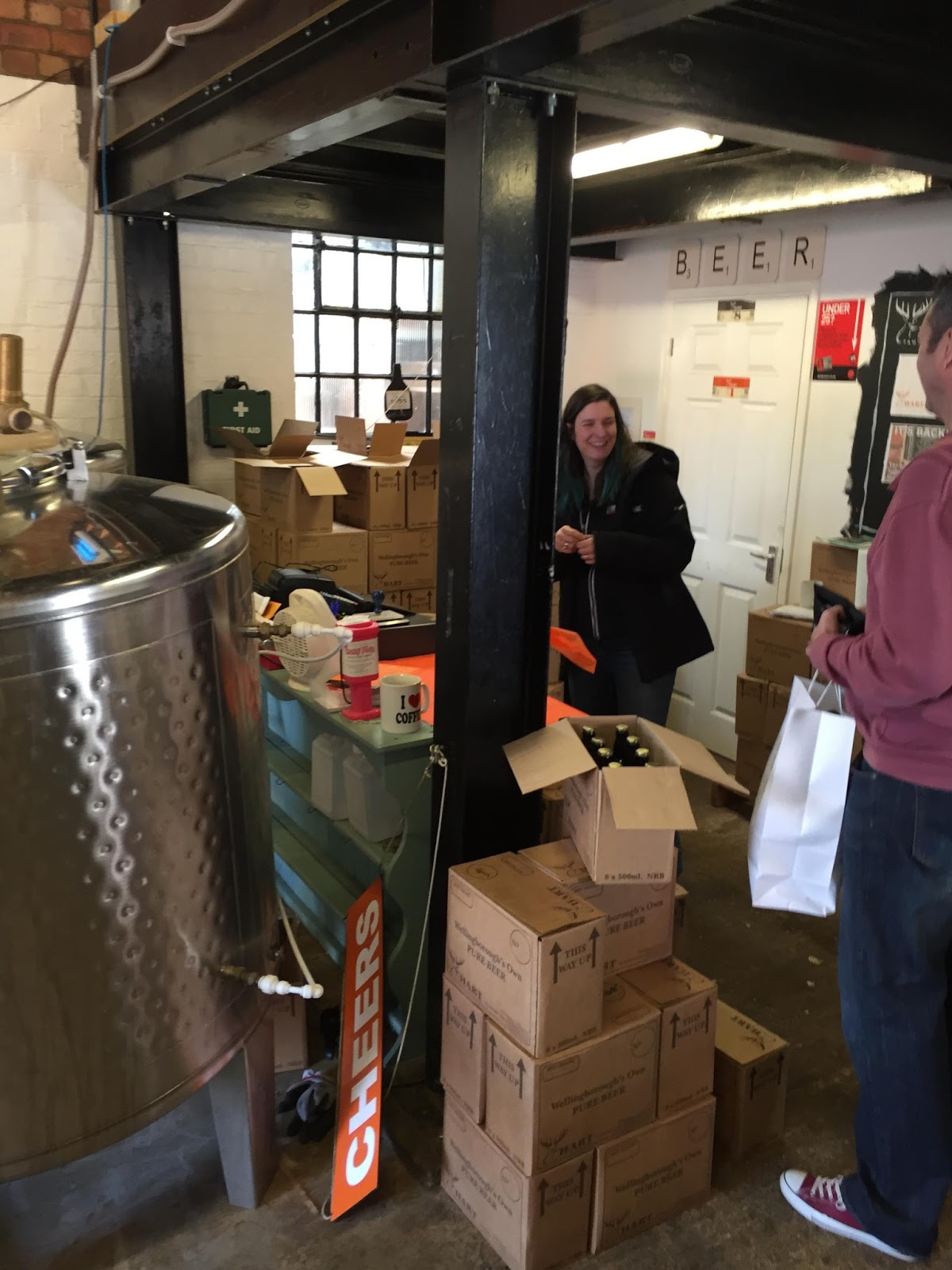
The next thing that struck me was the simplicity of the equipment. I got the impression that this was a scaled up version of a home brewery. No frills. A simplified process of batching. 

Aside from add-on temperature control I didn't see any sign of automation in place.  The temperature control comprised a glycol-based chilling unit linked to the fermenters with poly-tubing. 


Even the bottling is done by hand, with the bottling equipment conveniently stored on top of a Mash Tun until the next weekly bottling run. 


Stock is stacked at the reception and payment area to remind you what this business is about - craft beer, passion, innovation, improvisation - an entrepreneur's dream. 

The tasting was excellent - small little clear transparent plastic 'glasses', which enabled the taster to see the colour and appreciate the clarity. The aroma of the beer told me that the temperature for tasting was just right. The beers are branded with an elegant label displaying a stately steed on a uniform colour background that corresponds to the type of beer.  The product line is numbered and the label contains a well balanced amount of information about the beer flavour and content. Following the tasting, this was the selection that I liked and bought:


The beers were packaged in boxes with simple markings and perfectly designed to hold 8 bottles nice and snuggly. 

My favourite was No. 9, a 'lush golden beer with a crisp, hoppy flavour', and 4.3 per cent alcohol by volume.  The back of the label describes the taste as being 'crisp and refreshing and brewed using UK Cascade hops lending fresh, citrus flavours'. 

One of the things I don't like about commercial beers is the amount of fizz introduced artificially by injecting carbon dioxide into the beer under pressure.  The way craft brewers get some fizz into their beer is to place some yeast and a bit of extra sugar in the bottle before it is capped so that a secondary fermentation can take place in the closed bottle (creating pressure) and dissolving the CO2 produced during the fermentation. The price one pays for this is that the bottle contains some yeast sediment, and can make the beer slightly cloudy when agitated during the handling or pouring process.  

All in all this visit was a delightful experience and I will be enjoying their beer for a few weeks to come.